| A webinar series that highlights impactful research within the spinal cord injury community. Each webinar will be introduced by a member of the TSCIR editorial team, who will outline the webinar’s focus and introduce a featured paper. |
The New 2026 ISNCSCI Edition – Eminence guides Evidence
Friday, October 30, 2026 | 12:00 pm ET
>>>>REGISTER HERE<<<<
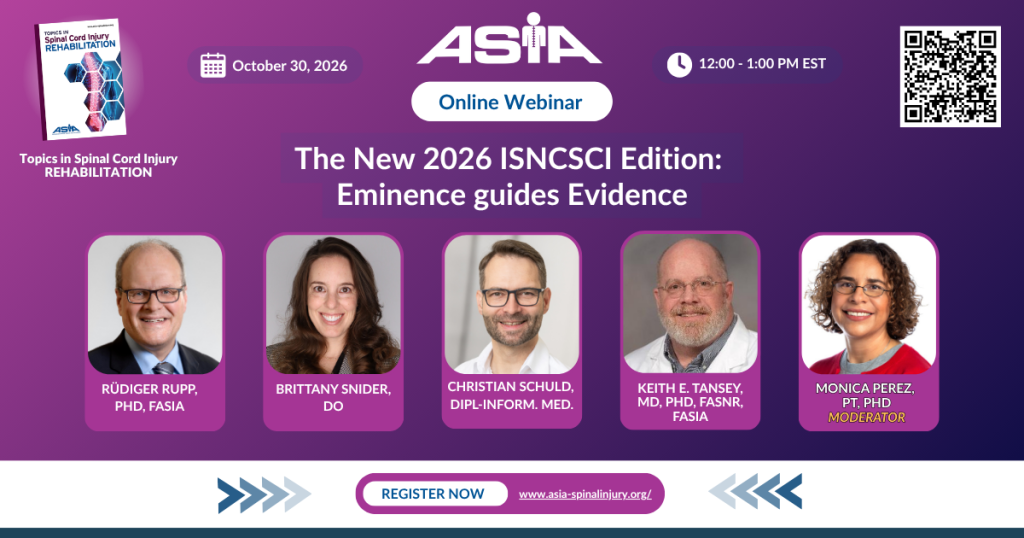
The International Standards for Neurological Classification of Spinal Cord Injury (ISNCSCI) represent the internationally accepted standard for documenting the sensorimotor impairment following a spinal cord injury (SCI). It is specifically used to determine the level and severity of SCI. From time to time, ASIA’s International Standards Committee publishes new editions of the ISNCSCI to include the most recent evidence and to address the need for clarifications. While the 2019 edition introduced fundamental concepts – namely the non-SCI taxonomy to document impairments not caused by the SCI and a new definition of the Zone of Partial Preservation applicable also in incomplete lesions -, the new 2026 edition focuses on closing definition gaps and providing additional information to enhance understanding.
For the changes of the 2026 edition, the International Standards Committee make consequent use of large longitudinal databases with ISNCSCI datasets together with validated ISNCSCI computer classification algorithms to simulate and validate ISNCSCI changes proposed based on clinical experience.
In this webinar, members of the International Standards Committee will highlight the changes introduced with the 2026 edition together with the committee’s consistent decision making and consensus processes established over the last years.
MODERATOR:
Monica Perez, PT, PhD
PRESENTERS:
Rüdiger Rupp, PhD, FASIA
Prof. Dr.-Ing. Rüdiger Rupp received the Dipl.-Ing. degree in electrical engineering with focus on biomedical engineering and his Dr.-Ing. degree from the Technical University of Karlsruhe, Germany, in 1994 and 2008, respectively. He received his venia legendi in 2018 in Experimental Neurology from Heidelberg University and since 2021 he has a professorship for Assistive Neurotechnology at Heidelberg University. After working at the Institute for Biomedical Engineering and Biocybernetics (Prof. G. Vossius) until 1996, since 1997 he is with the Spinal Cord Injury Center (Head: Prof. N. Weidner) of Heidelberg University Hospital, Heidelberg, Germany, where he holds the position as the head of the section Experimental Neurorehabilitation. His main research interests are in the field of rehabilitation engineering for people living with spinal cord injury. This includes neuroprosthetics mainly of the upper extremity, man-machine interfaces, gait analysis, development and clinical validation of novel methods and devices for locomotion therapy and realization of software projects for standardized documentation of rehabilitation outcome. He is author of more than 340 journal, book chapter, textbook and conference publications and holds two patents. He has been awarded several times for his work and is a member of IEEE, IFESS, VDE, DMGP, DGOOC, NervClub, ISCoS and ASIA. Since 2017, he is chair of the ASIA International Standards Committee. He is secretary treasurer of ASIA, board director of DSQ and president of the DMGP.
Brittany Snider, DO
Dr. Snider is Chair of the Division of Neurological Rehabilitation within the Department of Physical Medicine and Rehabilitation at Mayo Clinic. She is board certified in PM&R and Spinal Cord Injury Medicine. Her clinical practice focuses on the care of individuals with spinal cord injury, with the goal of maximizing function, optimizing overall health, and enhancing quality of life. She is honored to serve on the ASIA International Standards Committee and contribute to its important work, including ongoing updates and maintenance of the ISNCSCI. Dr. Snider’s research focuses on the use of the ISNCSCI to predict neurological recovery, the prevention and management of secondary complications following SCI, and rehabilitation interventions, including neuromodulation.
Christian Schuld, PhD
Dipl.-Inform. Med. Christian Schuld has been a research associate at the Spinal Cord Injury Center at Heidelberg University Hospital in Germany since 2005. He is a member of the American Spinal Injury Association (ASIA), the International Spinal Cord Society (ISCoS), and the German-Speaking Medical Society for Spinal Cord Injury (DMGP) and serves on ASIA’s International Standards Committee for more than 10 years. His research focuses on the International Standards for Neurological Classification of Spinal Cord Injury (ISNCSCI) and on improving walking function in neurological rehabilitation.
Keith E. Tansey, MD, PhD, FASNR, FASIA
Keith E. Tansey, MD, PhD, FASNR, FASIA, is a Physician Scientist with Restorative Neuroscience Consultation in New Orleans, LA, USA. He also works as a Medical Director for Paradigm, the Consulting Director of Clinical Research at Lifeward, and as Medical Science and Research Development Liaison Consultant for Avazzia. Dr. Tansey received his education and training at Stanford University, the University of Texas Southwestern Medical Center, Washington University and the University of California at Los Angeles. Dr. Tansey was first board-certified in Neurology and then earned additional subspecialty certifications in Spinal Cord Injury Medicine and Neural Repair and Rehabilitation. He has served on the association boards of the American Society for Neurorehabilitation (Fellow) and the American Spinal Injury Association (Past-President and Fellow). Dr. Tansey has studied plasticity in neural circuits for pain, autonomic function, locomotion, and upper extremity function in animal models and humans after spinal cord injury, with an interest in shaping that plasticity to improve functional recovery.
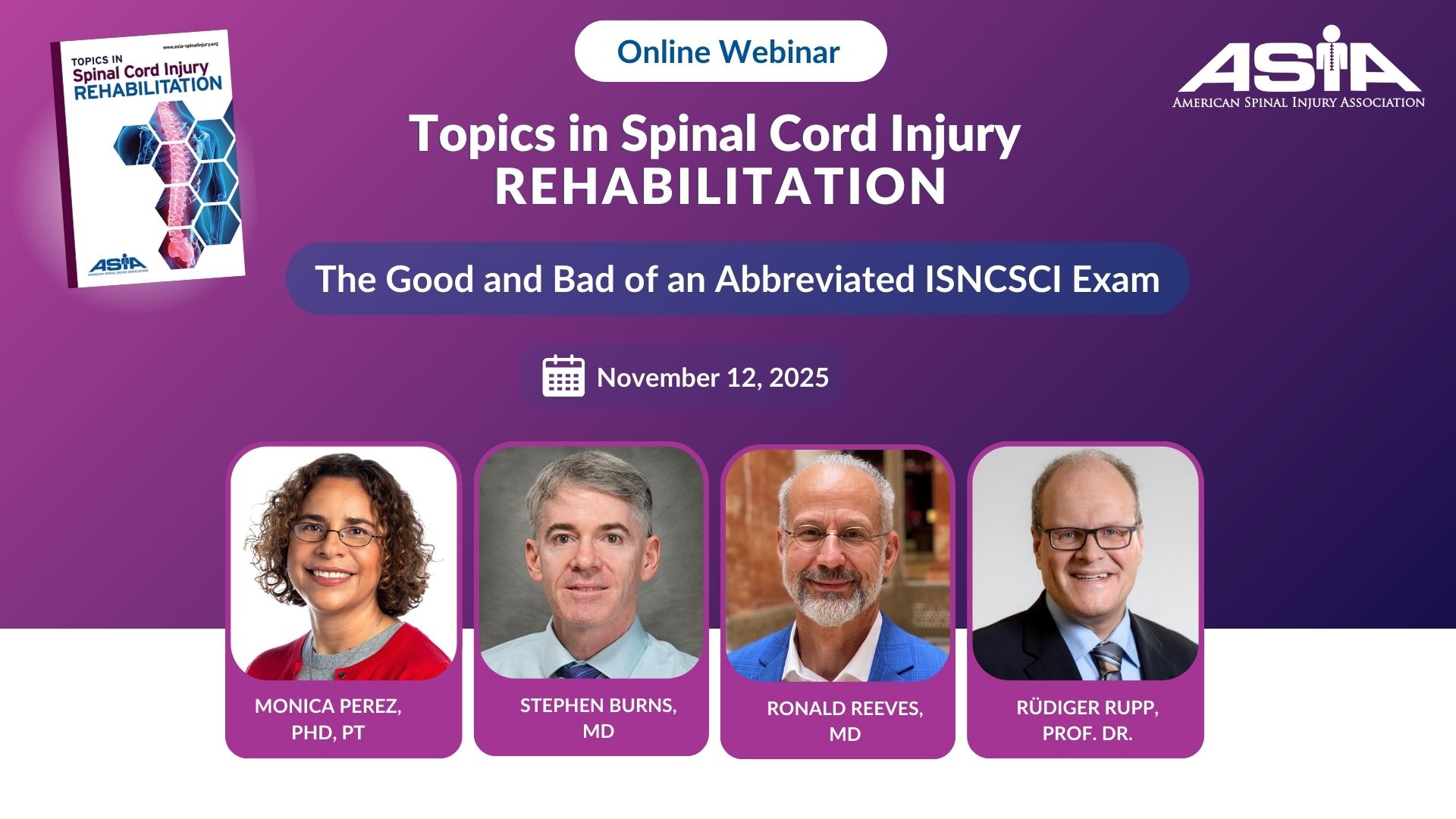
TSCIR Webinar: The Good and Bad of an Abbreviated ISNCSCI Exam
Wednesday, Nov. 12, 2025
Webinar Recording – Click here
Q & A from the 11/12/2025 TSCIR Webinar on E-ISNCSCI
 Featured Articles:
- Development and Validation of an Algorithm for Item Reduction of the International Standards for Neurological Classification of Spinal Cord Injury Examination to Determine Level and Severity of SCI https://doi.org/10.46292/sci25-00008
- International Standards for Neurological Classification of Spinal Cord Injury: Case Examples Reinforcing Concepts from the 2019 Revision https://doi.org/10.46292/sci24-00049
- International Standards for Neurological Classification of Spinal Cord Injury: Classification Questions and Cases https://doi.org/10.46292/sci25-00013
- International Standards for Neurological Classification of Spinal Cord Injury: Revised 2019 https://doi.org/10.46292/sci2702-1
TSCIR Webinar: Motherhood after Spinal Cord Injury: Clinical Practice Guidelines
Tuesday, Jan. 13, 2026
Webinar Recording – Click here
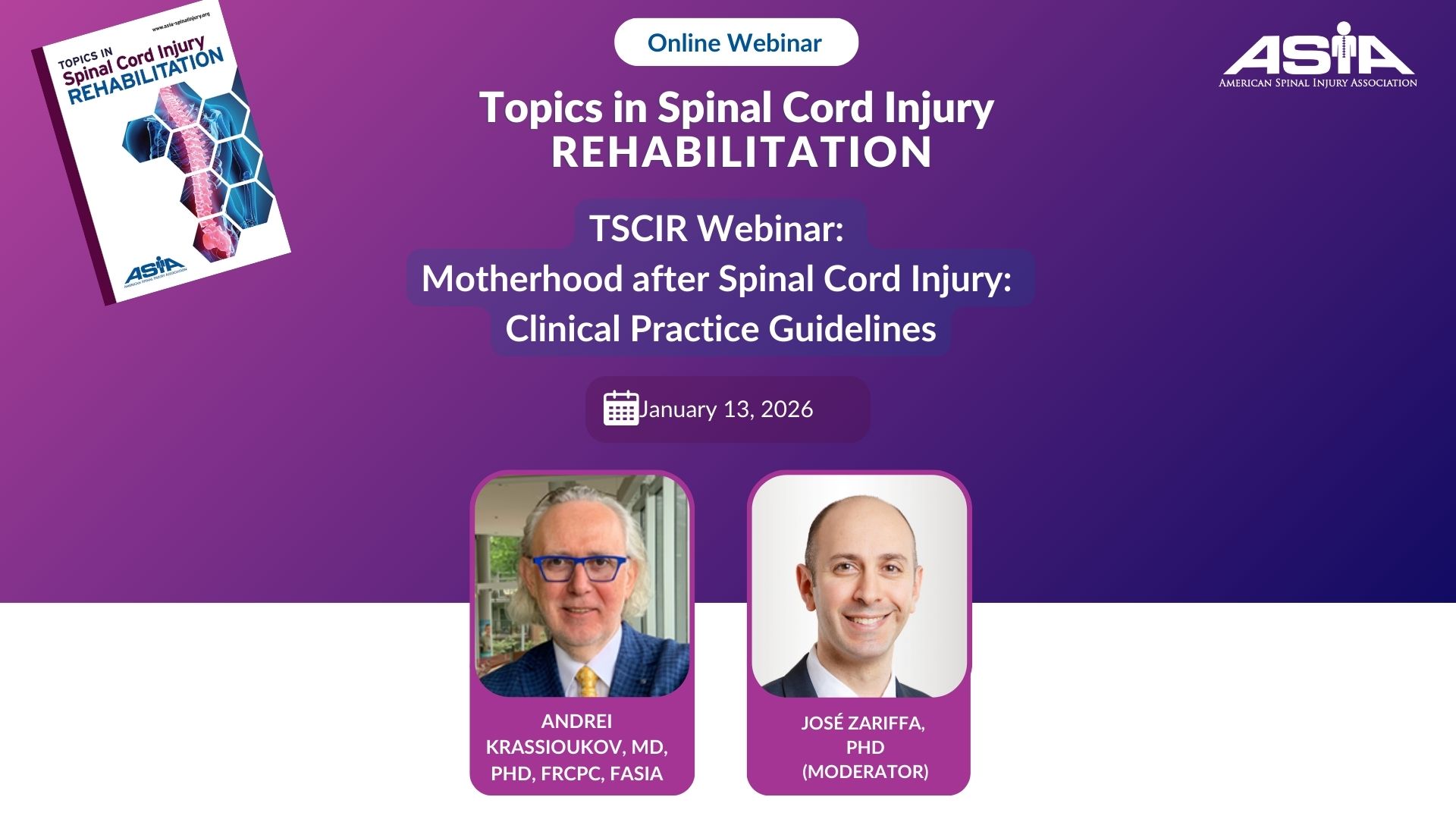
Motherhood after Spinal Cord Injury: Breastfeeding, Autonomic Dysreflexia, and Psychosocial Health: Clinical Practice Guidelines
Andrei Krassioukov, MD, PhDCorresponding Author; Stacy Elliott, MD; Shea Hocaloski, RN, BTechN; Olga Krassioukova-Enns, MD; Karen Hodge, MSW, RCSW; Stephanie Gillespie, RN, IBCLC; Sherry Caves; Teri Thorson; Lindsay Alford, BSc OT; Melanie Basso, RN, MSN, PNC(C); Laura McCracken, MSc; Amanda Lee, MSc; Kim Anderson, MD; Elena Andretta, MD; Harvinder Singh Chhabra, MD; Claes Hultling, MD, PhD; Christina-Anastasia Rapidi, MD, PhD; Fin-Biering Sørensen, MD; Ineta Zobina, MD; Francois Theron, MD; Allison Kessler, MD, MSc; Frederique Courtois, PhD; Maryam Berri, MD
Top Spinal Cord Inj Rehabil (2024) 30 (2): 9–36.
https://doi.org/10.46292/sci23-00079
TSCIR Webinar: Exploring the Landscape of Biomarkers in Spinal Cord Injury
Wednesday, Feb. 25, 2026
Webinar Recording – Click here
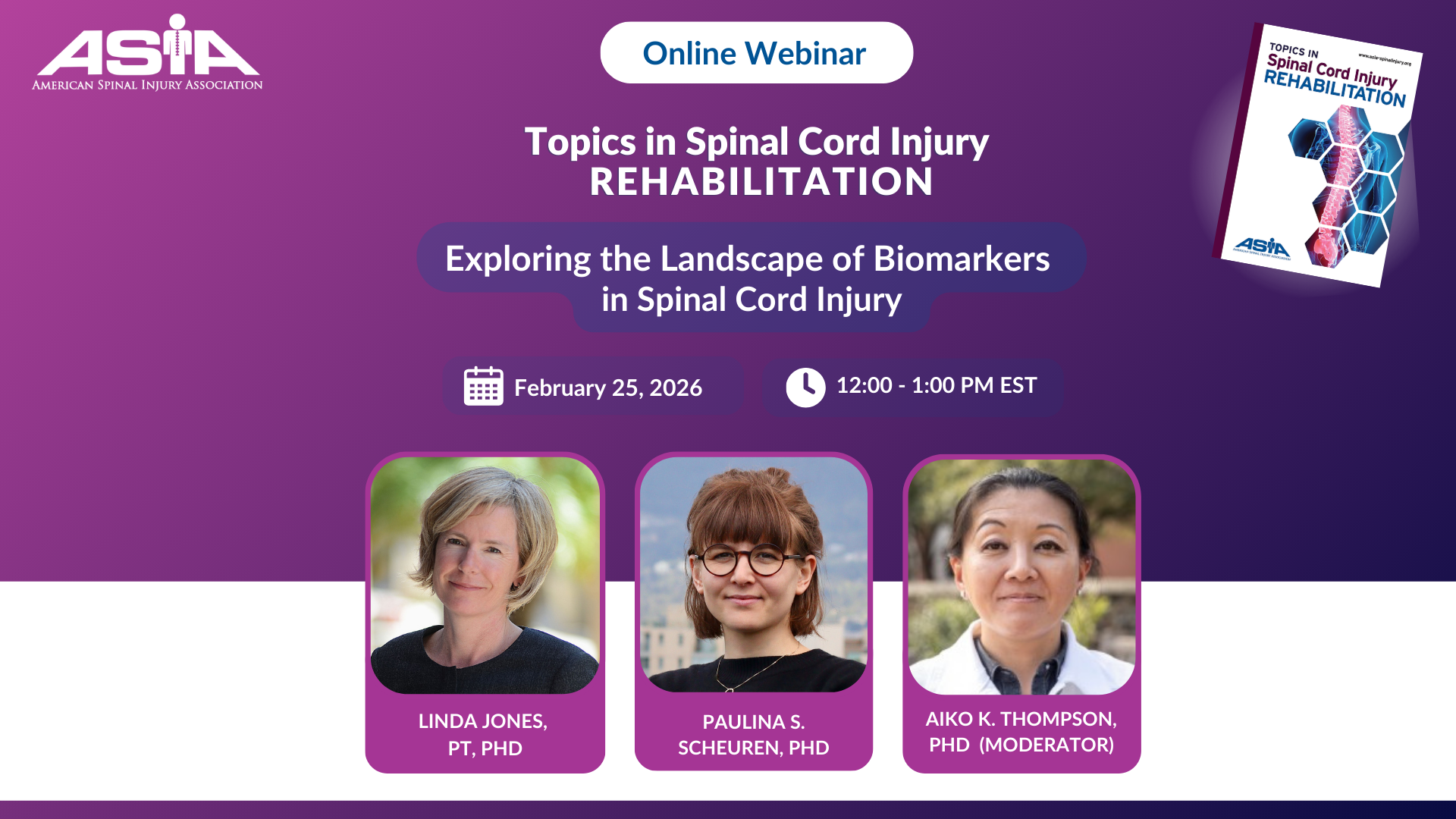
Exploring the Landscape of Biomarkers in Spinal Cord Injury
Paulina S. Scheuren, PhD; Bethany R. Kondiles, PhD; Angela R. Filous, PhD; Ona E. Bloom, PhD; Diana S.-L. Chow, PhD; Edelle C. Field-Fote, PT, PhD; Patrick Freund, MD, PhD; James D. Guest, MD, PhD; Brian K. Kwon, MD, PhD; Nikos Kyritsis, PhD; Chris Leptak, MD, PhD; Monica A. Perez, PT, PhD; Matthew Szapacs, PhD; Christopher R. West, PhD; Keith Tansey, MD, PhD; Jane T.C. Hsieh, MSc; Linda Jones, PT, PhD
Top Spinal Cord Inj Rehabil (2025) 31 (2): 1–12.
https://doi.org/10.46292/sci24-00076
TSCIR Webinar: Objective Measurement of Neurogenic Bowel Dysfunction
Wednesday, April 8, 2026
Webinar Recording- Click Here

Managing neurogenic bowel dysfunction in individuals with spinal cord injury (SCI) is often challenging and poorly understood, frequently necessitating iterative trials of medications, dietary modifications, and per-rectum interventions. A major barrier to advancing neurogenic bowel care is the absence of routinely implemented objective measures that adequately characterize bowel function in the SCI population. Although no standardized gastrointestinal function measures are currently recommended for this purpose, such measures likely exist.
To address this gap, we conducted a systematic review of the neurogenic bowel literature across neurologic populations to identify available objective assessments and to evaluate their clinical application and utility. While we identified several objective measures with potential clinical relevance, most demonstrated weak correlations with subjective assessments of neurogenic bowel function. These findings suggest that comprehensive evaluation of neurogenic bowel dysfunction requires the complementary use of both patient-reported outcomes and objective physiologic measures. In this webinar we will discuss some of these outcome measures and their clinical feasibility.
Moderator:
Eimear Smith, MD
Presenters:
Argyrios Stampas, MD, MS
George Triadafilopoulos, MD
| About the Journal As the leading resource for peer-reviewed state-of-the-science information on spinal cord injury and disease, Topics in Spinal Cord Injury Rehabilitation (TSCIR) is an interdisciplinary journal devoted to the study and dissemination of practical and theoretical information related to the subject of spinal cord injury rehabilitation.TOPICS IN Spinal Cord Injury REHABILITATION |
|